Wednesday, 17 February 2016

The Great Tyranny


Introduction
The greatest legacy left to humanity by the Romans was not their political organization, military prowess, unyielding spirit, culture, bath tubs and spars, technology, but their law. The authoritative writings of classical Roman jurists as codified by Emperor Justinian in Corpus Iuris Civilis are arguably the basis of many legal frameworks still subsisting in the world today, almost 1,487 years later. However, people should not lose sight of the fact that the refinement of law in cosmopolitan Rome or Constantinople was a progressive process emanating from earlier civilizations. The Roman law itself borrowed heavily from the writings of Greek Philosophers, particularly Socrates, Plato and Aristotle.  It is fundamentally true that Greek civilization itself has its roots in the Egyptian civilization, whose origins were at Kush and the progenitors of such a civilization being Nubians, or blacks of Africa. Those who are too prejudiced to accept these facts should dig into history and they shall found that Plato, at his prime age had travelled extensively and one of his destinations of choice, and chiefly for acquisition of knowledge and perhaps cultural sophistication was Egypt. That history can not be erased or concealed even by resorting to desperate shenanigans of hacking off the heads and/or defacing artifacts and statutes at the Great Pyramid of Giza.
Statute of Great King Khufu who built the Great Pyramid of Giza, with its nose obliterated.

Defaced Great Sphinx of Giza in the foreground and Great Pyramid of Giza in the background
 
Pharaoh Djedefre, son and successor of King Khufu, his nose did not escape the chisel of the racist. 

Roman law was strict and perhaps harsh, nonetheless Romans believed strongly in the rule of law. Court cases were followed by crowds in Rome both for familiarization with legal processes and also for entertainment. The Romans themselves acknowledged this when they said, Dura lex, sed lex”, meaning a harsh law, but a law nonetheless.

Emperor Justinian, one of the renowned Roman Emperors
 To graphically put across the reverence and respect of law by Romans, I quote a fellow Blogger, Panagiotis Limnios,In 280 BC, Pyrrhus of Epirus defeated the Romans in a major battle near Heracleum and captured 2,000 legionnaires as prisoners. This was a massive blow to Rome and during negotiations for peace, Consul Fabricius requested that Pyrrhus release the prisoners and allow them to return home for the holidays so that their families can pressure the Senate to surrender. Pyrrhus agreed on the condition that they return back to the prison camps if the senate voted against peace. 


Philosopher Plato
Consul Fabricius agreed and the prisoners promptly returned home. However, not only did the Senate vote for the war to continue, they honoured their agreement and ordered all 2,000 prisoners to march themselves back to Pyrrhus' camps and imprisonment under the penalty of death is they didn’t.”

However, despite the positives which were brought by law, particularly in the lands of barbarians, savages, bandits, pirates and mercenaries, together with the sophistication of the human race, it is ironic that the same law has taken a new dimension. Today the law is now a tyranny, encroaching on freedoms and civil liberties, practically enslaving citizens who helplessly serve pieces of paper littered with biased, unjust statutes promulgated whimsically by politicians, for purposes of entrenching their positions. This is happening in the poorest and smallest nations of the earth as well as in the most developed and biggest nations of this known universe.
Below we provide hard evidence of the current status quo, which shows how humans are now serving the law.

Police Officers or Revenue Officers
Traffic police officers have ceased to be law enforcement agents in many parts of the world, as governments shamelessly turned these protectors and implementers of peace into a mercenary force brazenly robbing the motoring public on daily basis of their hard earned cash. This is truly unacceptable as it is unjust, unlawful and unconstitutional. 

This also dovetails to the fact that governments now believe that fines can be used as a source of revenue for the fiscus. This at law is very wrong. Fines are not a source of revenue for treasury; rather it is a judicial principle, wherein a fine is a deterrent measure meant to discourage bad behaviour. In fact we can borrow from Roman law where the principle of restitution was a cornerstone of the legal processes, a principle also prevalent in African customary legal practice. The reasoning being that if a crime has been committed, every effort should be harnessed to ensure that the aggrieved party’s position is restored to earlier position before the crime was committed – put simply the perpetrator should compensate the aggrieved party to the extent of the damage suffered. However, revenue officers aka police traffic officers don’t care about that as they are interested in meeting targets set by their senior officials, including mayors and politicians.

According to a research made by Adi Eyal, from Code4SA, the Ubuntu Municipality in the Northern Cape Province of South Africa, strategically located on a major highway (N1) between Cape Town and Johannesburg and includes towns of Victoria West, Richmond and Loxton reportedly issued R52 million in fines in 2014, contributing almost half of its annul total revenue of R107 million. He concluded that this suggests that traffic fines are considered to be a major source of income for the municipality of only 20 000 residents, whose rates base is obviously low.
The main infringement through which revenue officers of Ubuntu Municipality are making a killing is over speeding. Thus, they set speed traps which are obviously engineered to trick drivers instead of aiming to reduce deaths. If the traffic officers were genuinely interested in reducing the road carnage, they will not hide awkwardly on road bends or behind bushes or trees only to emerge triumphantly when ticketing the offenders, but will be visible on the highway so that those motorists who are in the habit of speeding would not dare doing that in the presence of law enforcement officers. 

 
A police officer behind trees with a speed trap
Overall Eyal found that R1 billion ($100 000 000) flowed into the coffers of South Africa municipalities during the financial year ending June 2014. Excessive fines seem to be levied in Western Cape and Northern Cape provinces, while motorists in Eastern Cape and Free State provinces are better off.  Let’s just imagine that if one is driving from Cape Town and your destination is Cairo in Egypt, what kind of fines will you eventually pay, including numerous toll gate fees, initially designed for road funds, but have been shamelessly turned into revenue raising tools by governments, national border charges, some border fees within national borders, numerous illegal road blocks where patently corrupt police officers will extract from you exorbitant illegal spot fines. Surely you will be bankrupted and by the time you reach the shores of Mediterranean sea, you will become a destitute and promptly commence begging on the streets of Egyptian cities and depending on your visa, may be arrested on yet another immigration law infringement and languish in the underbelly of Egypt, where you are likely to die due to stress and thrown in a pit, a mass grave where nameless, unclaimed souls without relatives or friends are “buried” and disappear from earth without trace and forgotten because one thing- tyrannical laws. 

And don’t fool yourself in thinking that you can take a shortcut route, say from the East Coast, as you shall realize that from Mombasa, a port city in Kenya to Kigali, the capital of Rwanda, there will be no less than forty (40) road blocks.

A traditional leader in Zimbabwe’s Manicaland Province intimated that people should not be forbidden from committing crimes in his area of jurisdiction so that the Chief’s court would be able to raise revenue for the sustenance of the court’s operations. He was savaged by the media, supported by feminists as the issue involved child marriages. However, despite the Chief’s misplaced and misguided reasoning, he was honest. There is no difference between the chief’s rationale for revenue collection and that of elected and presumably educated and learned city mayors who prey on unsuspecting residents to collect revenue to fund their excesses. Mayors in Africa pursue ostentatious lives and drive top of the range German saloons and obscenely expensive imported SUVs, putting pressure on municipal coffers and eventually resorting to desperate means of raising revenue, turning themselves into blood thirsty vampires, squeezing all liquidity from households. With the Chief, a special crash programme to bring him up to speed with judicial processes and the rights of children, especially the girl child will suffice but there is no hope with educated mayors who know the right things but proceed to do the wrong things. Of course they (mayors) should be relieved of their duties, for they have failed dismally to discharge their mandate of protecting and empowering citizens.     

A government (central, federal, provincial, municipal) should not focus on revenue collection per se but rather on how to grow the cake - economic growth. Once their economies are growing by attracting and sustaining investment from both locals and foreigners, they will see that their revenue will naturally increase through legitimate revenue collection methods, such as agreed and reasonable rates, fees, levies, taxes, royalties and so on. So one of the most important performance measurement criteria of public servants is how they had fared in generating more revenue through economic growth and certainly not how much revenue they have collected from robbing poor and defenceless Peter, and in this particular case not even bothering to pay Paul. The bottom line is that all these fraudulent, immoral, unjust, illegal and nefarious activities are supported by law. The law has thus been turned into a tyranny, pauperising, tormenting and terrorizing law-abiding citizens.

Road blocks have also taken a racial dimension. Road blocks are mounted as early as 7:30 am in black neighbourhoods, and almost at one’s gate, such that as reverse your vehicle out of your property you are already tormented by revenue officers, whilst there are fewer or no road blocks in predominantly white neighbourhoods. Even in highways white folks are rarely stopped, meaning the burden for funding treasuries of municipalities is squarely on the shoulders of the black community – what an injustice, especially 60 years after Uhuru, when we celebrated the dismantling of the twin evils of colonialism and discrimination. 

Remember, we are not on a crusade of discrediting law enforcement agents, for we are aware that they took an oath of following orders from their superiors. Indeed when I was a young boy I was told sternly by my elders that when you set your eyes on a police officer, you would have seen the head of state. It follows that the officers are merely enforcing instructions which emanate from our esteemed chambers of governance – the legislatures.

The Law Makers
The misleading thing about the aforementioned statement is that parliamentarians or councillors have the capacity to make laws. Surely that is blatantly inaccurate that these representatives of the populace know how to make law, a specialized and scientific area of study. A parliamentarian or councillor just elected to the august house or city chamber suddenly becomes a law expert and thus a maker of laws. From the onset it should be noted that that whilst these elected officials have the mandate to debate bills, the mandate derived from the populace, the law making aspect needs to be approached carefully. 

The parliament, in my considered view, is a cog of governance, which first and foremost should concern itself with counter balancing the excesses of the executive and even the judiciary.
It is therefore a great misnomer if parliamentarians and councillors are called law makers.  It is equally unfortunate that parliamentary and municipal chambers where we have send community representatives have been turned into factories churning out unjust laws day and night. Thus, the developmental agenda has been relegated to the periphery. In Africa the issue is gravely compounded by the fact that parliaments are gravely ineffective. The senior cabinet ministers and even prime ministers and state presidents openly undermine these vital institutions of governance. They, despite ample notices given to them to come to parliament and answer questions affecting the people in their capacity as the executive arm of government, deliberately and persistently abscond on debates, without even bothering to notify the speaker of parliament. That behaviour is totally unacceptable and should not be tolerated. The portfolio committees are toothless bull dogs or even worse, puppies, who continuously bark the right sounds, depending on the dog specie but can not bite, for they have neither the stamina nor the teeth. 

The voting patterns in parliament are also severely compromised because of a bizarre whipping system. Political parties in parliament invest heavily in a whip, which is then handed over to a mysterious party official, whom they call a Chief Whip, and whose principal role is to whip other party members each time there is a controversial bill to be passed in parliament. Thus, the Chief Whip is indeed like a cattle herder, brandishing a long whip, which he unleashes on the beasts of burden, for them to follow his instructions. So now the honourable members of parliament have now been reduced to mere four-legged animals requiring a whip to follow the party line, even if it’s absurd, unconstitutional and illegal. It is clear that politicians are very much capable of making outright lies to the public to get bad legislation passed.

It is precisely due to the status quo that we are burdened by these unreasonable, unjust laws which squeeze people and drive them to desperate situations. In fact this fraud and corruption is the chief cause of poverty in some parts of the world, including Africa.

However, one will be forgiven to believe that this problem is confined to the developing world. In the developed world the situation is even worse. There are about 20,000 laws just governing the use and ownership of guns in United States of America (USA). New laws mean new crimes. In this prosperous country, the laws are so many that even if you ask the most senior legal person to shed light as to actual quantum of laws subsisting in the union  he/she will not give you an answer. It’s like everything has been criminalized. A democracy has indeed become a tyranny. To drive a point home, 1 in 40 Americans is a convicted felon (serious offender). Surely these laws are not legitimate because they are imposed on people and their origins are not the people but whimsical feelings of politicians, who have abdicated their duty of governing but are now specialists in law making.

However President Obama is trying to reverse some of these unjust laws, notwithstanding the resistance he faces. According to Ken Mafuka, a columnist for the Financial Gazette, Zimbabwe, writing from America, “President Obama has released 6,000 prisoners whose sentences were intended to re-enslave blacks and he intends to release 60,000 more.” We applaud this effort and urge him to complete this noble task before he retires from active Presidency.

In 2010 alone the UK passed a whopping 3,506 laws and that was up 41% on previous year, and 1,788 or 51% were introduced by the Labour government before the elections. This is an incredible and alarming amount of legislations and you wonder as to the purpose of such overload. Add this to a plethora of statutory instruments issued by cabinet ministers then you have a real picture of the enormity of the laws in the Isles.  Do the ordinary people aware of these laws which politicians are nicodemously passing in cover of darkness?

There is a truth in the saying that the more corrupt the state the more numerous the laws.


The Prosecution Conundrum
The journey of one’s misery with the criminal justice system commences with an encounter with the arresting officer right to the correctional service. The whole conundrum of the arresting officer, investigating officer, prosecutor, the presiding officer (magistrate) and the correctional officer is ineffective and littered with so much injustice, inefficiency and down right unconstitutional actions. We highlight below the current position regarding this process.
·         For the greater part of their jobs, police officers’ activities are unconstitutional, for example:

     1. The budging of police officers in people’s homes without valid search warrants.

2. The arrest of suspects without ascertaining the reason. It is great injustice and violation of  one’s constitutional rights for police officers to arrest a person without attempting to understand the reason. We then wonder as to whether the police should arrest to investigate or investigate to arrest? If the investigation is not completed by the time the suspect is mandated by law to appear in court, then what happens? In most cases the police officers apply for extension of time for them to finalize the investigation, in the meantime the suspect is languishing in remand prison. Police officers don’t take it lightly if suspects they thought and believe would go to jail are freed by meticulous judicial officers. They should neither be angered nor disappointed because they would not have investigated the cases. So the Policing Curriculum at Police Schools needs to be revamped so that a police officer is that savvy investigating officer able to gather and analyse the evidence and thereafter make conclusions based on solid evidence, not the current state where an arresting officer is like a Robotic Cop, whose role is either to shoot the suspect or put chains on the suspects’ hands and sometimes his legs. If that was the case then we could save billions of dollars if we replace all human police officers with robotic cops, which do not clamour for new vehicles, uniforms, and other fringe benefits.

3. Police Brutality- This is a serious problem when the police force use excessive force against unarmed civilians. Police officers should not be trigger-happy or resort to acts which leave the name of the force in disrepute by becoming tyrannical, abusing vulnerable people like female suspects, foreign nationals or people of colour. We acknowledge that police face increased risk to their lives whilst serving communities. In South Africa, 58 police officers were killed by criminals between January and August 2015. Even if we discount the 34 officers who were killed whilst off duty, the number of police officers killed in line of duty is unacceptable. The solution is not then for police officers to ratchet up brutality against ordinary people. The police leadership should devise better methods of combating serious, violent crimes by sharpening the force's skills in combat, self-defence and gathering intelligence through working closely with community members, who are willing to volunteer important information about the activities of gangs, thugs and habitual serious offenders.  

·         The magistrates are no longer trying any cases. They just listen to the prosecutor, who also has interest in seeing the suspect jailed given the effort he/she would have expended on the case. The prosecutor would have also been impressed by the arresting and investigating officers to nail the suspect. Again it would be unusual for the prosecutor, who works with the magistrate on daily basis to then differ greatly on the merits of the case, thus for purposes of dispensing justice the relationship between the prosecuting office and the magistrate needs to be reviewed with a view of really separating these two offices both in theory and deed.

·     It follows therefore that if a suspect does not have a lawyer; he or she will surely be incarcerated or slapped with a hefty fine. However the whole purpose of building courts is for suspects to be tried in a fair and flexible humane manner, especially following a scientific procedure, a legacy which was left to us by the Romans. The poor are getting a raw deal and the rich are definitely getting away with murder. If an accused person has no legal representation magistrates become virtually sentencing agents, just passing sentences and don’t bother to go through the process of trial. Thus, magistrates are turned into robotic instruments of sentencing without trial of suspects. Again if this remains the case then perhaps we should also consider creating robotic judicial officers, which can replace human magistrates, saving a lot money and time.

·      The system is also clogged by numerous petty crimes which make magistrates less effective. Police officers usually embark on orgies of indiscriminate arrest of people, particularly close to year end when they are due for job appraisals. Fearing a back clash from their commanders for a lousy job because of few arrests, they just roam the streets arresting unlucky victims, with the hope that even if the victims are pardoned later, probably in the New Year, they would have earned higher scores on their job appraisals. The question then is: do we promote police officers on the number of suspects they arrest, or rather on their meticulous investigating capacity such that when the cases get to court they have higher chance of conviction?

·         Trial of cases takes place only in higher courts (High Courts, Supreme Courts of Appeal and Constitutional Courts) while in lower courts there is virtually no trial happening there except for haphazard, arbitrary and clearly guess work.  And even in higher courts there is a terrible trend which will upset the body of jurisprudence, whereby two cases with almost similar facts will receive different judgements by two different judges. This is serious injustice, because the law should be scientific and should uphold the concept of judicial precedent, to the extent possible.

·         Thus the conundrum of the arresting officer, investigating officer, prosecutor and magistrate is highly ineffective and colludes and perhaps conspire to achieve certain unconstitutional decisions, with far reaching repercussions on the dignity and rights of citizens and non-citizens.

A Verdict by the Jury
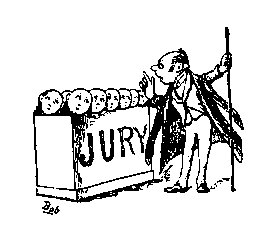
Trial and conviction by the jury is the most bizarre legal practice I have ever seen. Assembling legal laymen and women, even if they are people of integrity and of higher social standing, to the courtroom to hear trials of the most complicated criminal cases and expect expert judgements is sheer madness. Not only are the members of the jury excessively stretched in terms of legal principles, but they tend to be passionate and emotional, the very factors which should be banished when presiding over criminal cases. We just have to get rid of this judicial practice, and rely solely on the experts through the bench trial process. 


The beheadings
We condemn in the strongest possible terms the relentless beheadings taking place in the Middle East, ironically instigated by judges without affording the accused proper legal representation. The monstrous verdicts are therefore ad hoc, haphazard and clearly arbitrary and definitively illegal, murderous and constitute gross human rights abuses.

 The Hague Curse
The international Criminal Court has lost all its reputation, particularly in the eyes of Africans, and without fundamental reformation it will die a natural death. We shall tackle this curse in future instalments, preferably in the first half of 2016. Justice which is biased and lacks scientific approach and credibility is injustice, and no sane person would want to be party of that charade.

Conclusion
The tyrannical nature of law knows no boundaries, race, class, religion and transcends humanity. However it is perpetrated and cemented by political actors, irrespective of whether the country is governed in any of the following: multi-party democracy, autocracy, monarchy, religious-based rule, socialism, communism, cultural rule or any other sociopolitical structure, they all resort to tyrannical laws for their sustenance, protection, and defending their positions. They hide behind the law to violate human rights, which are sometimes listed in their constitutions. We therefore urge all governments across the face of the earth, from super-powers, emerging powers, developed countries, middle-income countries to developing countries, big nations, small land-locked countries and small Island nations to reflect deeply on the state of laws in their particular jurisdictions and chart a new way forward with a view of repealing draconian laws, and all other laws and statues promulgated to stifle human freedoms and assault on civil liberties and involve the communities in crafting FEW but relevant, legitimate laws to serve communities, and not for communities to serve the law. Lest we forget that God promulgated only 10 laws to multitudes of Israelites at Mount Sinai, who are we to create these kinds of unjust laws, on daily basis to drive the sons and daughters of man into misery and slavery? 

Thursday, 17 December 2015

THE WASTING RACE


INTRODUCTION

The human race has achieved tremendous milestones, particularly after the industrial revolution. Food production, labour specialization, efficient processing and transportation of goods among others were achieved allowing man to better understand and manipulate the environment for his benefit. It is against that background that readers will be shocked by the disparities in food production and consumption throughout the world. The topic of this essay, however, is focused on the food wasting habits of the human race. Humans have totally failed to emulate nature where wastage is negligible.  Humans compete with each other in throwing food in rubbish bins, which food will end up in landfills. The sheer amount of waste from humans is unbelievable and is costly. We are indeed a wasting race.

According to an authoritative report by FAO, almost a third of food produced in the world is wasted, and that translates to about 1.3 billion tonnes of food. The major culprits are the rich and famous, mainly located in the developed world, pursuing an ostentatious living, unashamedly wasting highly processed food, a whopping 222 million tonnes. In America alone food wastage amounts to 40% worth a staggering $48.3 billion. 

Excess food recovered by activists in America

This is despite the fact that 795 million people world wide are suffering from chronic hunger. In Sub-Saharan Africa, of which I am a proud citizen, 23% of the population is hungry.   Furthermore, 23 million of school going children in the sub-region attend school hungry, every day. The region produces only 230 million tonnes of food, meaning that if the developed world could channel the 222 million tonnes of food it dumps in landfills, the food deficit in our region could be easily be eliminated. 

Hunger kills more people in the world than AIDS, Malaria and Tuberculosis combined. In Africa the death toll from hunger can only be rivalled by witchcraft. 

 
A hungry child suffering from acute hunger

 The striking contradictions above make a compelling case for the human race to do something about hunger. Yes, there are reasons why the developing world is failing to feed its inhabitants but the issue here is that if the current food quantities available on earth could be shared equally and responsibly then there would be no one suffering from hunger. This is more pertinent when people are literally throwing food in landfills, oblivious of the cost involved. It will not be accurate to state that all food wastage, especially at retail and consumption stages occurs in the developed world only. Even here in Sub-Saharan Africa affluent members of the society are throwing valuable food in the rubbish bins, despite the fact that they live in the midst of hunger. It is bad behaviour to waste food when other people are hungry. It can easily be called evil when wasting food is done in greater proportions and consistently. Conversely conserving and sharing food is not only good behaviour but is Godliness. 

A man picking grain for his sustenance

When Jesus Christ fed multitudes from only five small loaves of barley bread and two small fish intended for a small boy’s lunch, the remaining food which filled twelve baskets was not thrown away. He personally instructed His disciples to ensure that all the food be conserved. He said, “Gather the pieces that are left over. Let nothing be wasted.” (John 6:12 NIV) When He was teaching his disciples how to pray to the Heavenly Father, there is line where He says, “Give us this day our daily bread”. 

The Great Ancient Egypt became more prosperous when Joseph, after being alerted by God, advised rulers there on the need to meticulously conserve food (grain) for seven consecutive years, without failure, in specially built silos. The trade of scarce grain at firm prices during the ensuing famine which lasted 7 years buoyed the Egyptian economy to greater heights.

When Israelites, the descendants of Jacob, where being led by Moses from Egypt to the Promised Land, some years later, God told them that each and every household would collect manna, a special food, in accordance with their needs: nothing more, nothing less. They were impressed to take portions they needed, and desist from hoarding food. Those who took more than enough were overwhelmed by maggots. Christians and Theologians have deeper interpretations but the above analogy is relevant to our very topic of wasting food, through buying more than the legitimate needs of your household. 

So what is the cost of wasting food?
The costs of wasting food can be categorised as economic, social and environmental. Economic costs relate to the wastage of valuable and expensive resources such as electricity, fertilizers, fuel, pesticides, labour, and capital to grow and rear food, only to throw the same in landfills. It’s literally burning cash. 
The environmental costs emanate from deforestation as farmers continue to expand their plots to meet a fake demand of food (because purchasing managers of retail shops and manufactures continue to order and produce food at a pace where consumers are not consuming the food), depleted water supplies, biodiversity loss, massive fossil fuel consumption. All these things, together with release of methane gas in the atmosphere from decomposing food in landfills, heighten the greenhouse effect which makes the earth warmer causing sudden and dramatic changes to climate. 

The ensuing social upheavals manifest themselves in increased pollution causing deadly diseases like cancer that decimate populations, reduced farmer incomes causing high incidences of poverty, increased social ills as households attempt to adjust to loss of income resulting in outbreak of STIs and increased crimes leading to overcrowded jails,  lost livelihoods and eventually outbreak of civil strife resulting in loss of lives due to civil wars, cross-border armed conflicts, break down of law and order where hope is totally lost and communities progress is derailed, as militias and bandits take centre stage, brandishing machetes and automatic weapons, declaring themselves as governments and rulers of man, by ironically enslaving people and committing heinous crimes that even the most educated and experienced international jurists and barristers will fail to fathom. Such is the cost of habitually throwing food in the rubbish bins!   

The wealthy people should be reminded sternly that the personal cost of throwing food is immeasurable. These people who live like royals should remember the infamous Queen Antoinette of France. Upon being informed by aides at the Royal Palace on the predicament of the malnourished populace, seeking audience with the rulers on the pressing need to obtain the basic cereals to make their daily bread,  she subconsciously retorted, “Let them eat cake.”  That statement, without exaggerating, was a turning point in the famous French Revolution and she eventually lost her head, when the revolutionaries borrowed her head and never returned it back.

The total cost of wasting food in monetary value is conservatively estimated at $2.6 trillion.  

Where is Food Wasted?
Research has shown that food is lost principally at consumption stage both in developed and developing world. In developed countries food is generally plentiful and many households can afford to purchase great quantities of food items. There is a terrible habit of the rich where they continue buying food even if their pantries are full. Shopping as a hobby is inappropriate, however shopping food as a hobby is highly irresponsible. People should buy food quantities they fully utilize. There is also lack of coordination between retail chains and farmers and manufactures leading to overproduction and overstocking at retail chains resulting in food, processed food for that matter, being literally offloaded in landfills – what a waste by this race?
In Sub-Saharan Africa, food is also lost at pre-harvesting, harvesting and post-harvesting stages due to inadequate infrastructure and technology for preservation and value addition. However we reiterate that the main culprits of food wastage in these localities are actually the rich who flaunt their wealth by throwing food in rubbish bins. Even the middle class and low income earners, when they are doing well financially are seen throwing great quantities of food in the rubbish bins, copying the terrible habits of the rich. 
Valuable food being offloaded in landfill
The Pet Dilemma
Dogs and cats of this world are well nourished, when humans are starving. Animals, it would appear, have more rights than humans. During the colonial era in Africa, the colonial master would keep his dog on the front seat of his van, while his worker (servant) was at the back of an open truck, even in extreme weather. Without exaggerating, this was one on the long list of grievances why the war of liberation was waged against colonialism. It symbolized and confirmed extreme segregation, oppression and discrimination in that the dog, a four legged beast, was considered superior to a human or put this way, the master’s dog was treated far much better than a fully grown up African person, who happened to be a parent, and sometimes an heir to the throne of a Kingdom or clan. 

Needless to say that some of black people who replaced the European settlers in the social hierarchy, condemned their fellow workers to the back of the open truck, even in extreme weather. It is very disheartening that some black people are actually no longer allowing their fellow black workers to take refuge at back of the open truck, who then resort to walking, even in extreme weather. This was aptly observed and captured by George Orwell in his legendary political satirical work, The Animal Farm, wherein farm animals after enduring the oppressive and negligent rule of a farm owner, Mr. Jones, revolted and expelled him from the farm, marking the triumphant revolution where all animals were deemed equal, even though pigs were still opinion leaders and therefore makers of laws. However, it was not long when the rest of the animals looked from pigs to humans and from humans and pigs and struggled to locate the pigs, for there was no difference. The pigs have just replaced Mr. Jones in the social hierarchy and were hell-bent in defending and protecting that position for self-benefit, discarding the ethos of the revolution: equality, freedom.


Solutions
The solution is very simple. People should stop wasting food. However, we know old habits die hard. A concerted effort by stakeholders, including governments, NGOs, developmental agents and activists, volunteers, community and religious leaders should redouble their efforts in conscientising society on the need to conserve food for the benefit of all and the well being of earth, the continuity of the human race and sustenance of future generations. Attitudes should change, and people should value food and wastage should be minimized and perhaps eliminated. These attitudes should be inculcated to humans as early as possible, at kindergartens and continuously taught relentlessly until it becomes a culture that food should not be wasted.  People should not throw litter anywhere and appreciate that nature is a living thing which needs care and that the relationship between the human race and nature is symbiotic and reciprocal. Nature cannot be expected to continue giving the human race while humans continue on a binge of squandering resources. It’s unsustainable and will surely come to an end with disastrous consequences to the wasting race- the human race.

Have a merry Christmas and Happy prosperous 2016. Let's remember the less fortunate by stopping food wastage.
 

Monday, 31 December 2012

Spirituality of Investment


During this festive season, when the world is celebrating the birth of a savior and redeemer, Jesus Christ, it will be befitting that we retrace and dedicate his ethos with regard to investment and philanthropy. In articulating the aforementioned the overarching question shall be, is there any relationship between investing and spirituality? The following is extracted verbatim from the unpublished work of Robert Mudzvova entitled, Investment World Demystified©.

The birth of Jesus Christ in Bethlehem
At face value, one would be forgiven to think that spirituality and investment are completely incompatible. The rich are seen as the curse for the poor. Many rich people mistakenly think that the poor are responsible for their impoverishment. The struggle between the poor and the rich started with the advent of capital. There are certain examples I have given in this book which amplify the “heartless” of the rich and the vulnerabilities of the poorest of the poor.

The struggle between the poor and the rich was therefore the subject and scope of the great essay by the godfather of philanthropy, Andrew Carnegie called the Gospel of the Wealth, of which the following was his submission:

“This, then, is held to be the duty of the man of Wealth: First, to set an example of modest, unostentatious living, shunning display or extravagance; to provide moderately for the legitimate wants of those dependent upon him; and after doing so to consider all surplus revenues which come to him simply as trust funds, which he is called upon to administer, and strictly bound as a matter of duty to administer in the manner which, in his judgment, is best calculated to produce the most beneficial results for the community--the man of wealth thus becoming the mere agent and trustee for his poorer brethren, bringing to their service his superior wisdom, experience and ability to administer, doing for them better than they would or could do for themselves.”

To Carnegie and indeed all the Carnegiests the world over, the rich will, “…but a trustee for the poor; entrusted for a season with a great part of the increased wealth of the community, but administering it for the community far better than it could or would have done for itself.”

However, the theme of this chapter is to draw parallels between spirituality and investing. Were the greatest philanthropists’ motives out of the good of mankind or the fear of hell or both?

The work of Carnegie is drawn from Biblical texts and there are several percepts to support this, “….Angels (in heaven) derive their happiness, not from laboring for self, but for each other”. And the basis for his philanthropy could have been motivated by Jesus Christ himself, when Carnegie asserted that laboring for the good of our fellow human beings was, “the essence of his (Christ) life and teaching.”

Andrew Carnegie, the godfather of philanthropy 
Carnegie laid the foundation of reconciling between the rich and poor by explicitly highlighting the guidelines for “repatriation” of the wealth accumulated by the rich to the poor. The basis for his thoughts and of course, his deeds, was that the rich should, where it is practical to do so, supervise and monitor the distribution of their wealth to the poor, using the wisdom and experience they exhibited when they were accumulating their wealth.

The profound ideas of Andrew Carnegie were indeed applied religiously by John D. Rockefeller Snr. of Standard Oil fame together with his son, John D. Rockefeller Jr. and ably assisted by Fredrick T. Gates. Rockefeller foundation was arguably the first philanthropist organization to be involved in a world-wide organized philanthropy. The main objective of the foundation was and is, “To promote the well being of mankind world-wide.” To the Rockefellers and all those that have benefited from their good cause, the essence of spirituality is abundantly evident.

These were rich servants of God, who had good intentions about the generality of mankind, particularly the poor and the vulnerable, for their wealth came from business acumen and power of investing and not from thievery or acts of evil.

Perhaps the greatest fear of hell was shown by Warren E. Buffet, in Berkshire Hathaway’s 2002 Annual report, where he said, “...Like hell, it easy is to enter and almost impossible to exit.” But it is true to assert that, he who fears hell is in essence obeying the teachings and deeds of Christ. Buffet in the same annual report, on giving his thoughts on corporate governance and corporate disasters which came due to lack of it, he went deeper into the scriptures when he referred to Jesus Christ’s teachings, who in Luke 16:2, said “Give an account of thy stewardship, for thou mayest longer be steward”

So it can be seen that from Carnegie, through to Rockefeller to Buffet and indeed to Bill and Melinda Gates, the notion of investing is evidently linked to spirituality. It is therefore not an irony that Andrew Carnegie the godfather of philanthropy was the second richest man in the world during the peak of his investing career only second to John D. Rockefeller Snr, the one who popularize the idea of wide scale philanthropy. This was in the late 19th century and early 20th century.

A youthful John D. Rockefeller Sr. of The Rockefeller Foundation 

 Today, Warren E. Buffet the greatest investor in living memory and indeed the greatest philanthropist of all time has committed to handover the greater part of his wealth to the Bill and Melinda Gates’ foundation, arguably making it one of the biggest foundations in the world. At the time of committing his wealth to the Gates, Warren was the second richest man, only second to Bill. These great investors had deep rooted beliefs in the teachings and deeds of Jesus Christ and that they were also rich spiritually.

In the Zimbabwe context, there are many philanthropists who have done a sterling job of assisting the poor. Jairos Jiri, for example, opened his house to the physically challenged and today his name is synonymous with empowerment of the physically challenged. We continue to encourage those who are taking care of the orphaned, the widowed, the elderly, the sick, the physically challenged and the poor that they continue on this path, for it is proper and fruitful. God will bless them abundantly. Jesus Christ encouraged us to help the poor and mentioned several times that poor have a right to the Kingdom of God.

Jairos Jiri, Zimbabwean philanthropist who empowered  many physically challenged people 
Giving generously to the vulnerable is as rewarding as successfully reaching the apex of Mount Everest. The fulfillment got is worth it. It is a legacy for real investors to leave for future generations and this shall not deplete their wealth, but shall usher new opportunities for so many investors to flourish and indeed improve the living conditions of mankind.

We thank most sincerely the visitors and readers of this blog. Together we are community wishing and hoping for the betterment of the suffering humankind. Going forward and God willing, these wishes and hopes shall be concretized into tangibles to endure any form of turbulence and machination from the wicked.

Have a Merry Christmas and a blessed and prosperous 2013

God Bless.

I thank you!

Friday, 21 September 2012

What Africans Really Want - Simple but Effective Technologies


Technology is known to be a game-changer when it comes to development. The industrial revolution which saw the complete transformation of agricultural and manufacturing industries in Britain and later in Western Europe, North America and Japan was premised on steam engine technology. That technology enabled a great leap forward of the human race, through enhanced productivity, as man was able to capture and unleash immense energy stored abundantly in water and coal.  The technology gap is a critical factor that explains the difference between economic development and prosperity between the developed and developing countries.

Today rapid technological advancement continues to take place in high income and middle-income countries, while insignificant technological progress is taking place in low-income countries.  This has been the case for centuries, thus condemning citizens of low-income countries to perpetual poverty. Anyone interested in solving the challenges of poverty, hunger and disease in Sub-Saharan Africa should boldly come up with strategies of reducing the yawning technological gap currently existing in the region. It’s true that in this part of the world people lack access to food, reliable electricity, clean water and sanitary facilities, health facilities, reliable transport, enough clothes, including shoes, stable and affordable broadband etc.

There are a lot of suggestions on how this gap can be plugged. Some advocate for technological transfer mechanisms, which allows the sharing of risks and rewards between the technology developer and the recipient country, institution or company. Technological and innovation diffusion proponents also argue that over time an innovation or technology can be passed to all members of the world community, subject to demographic and cultural factors. The other way is for less technologically advanced countries to just import the technology for production. Thus a country in Sub-Saharan Africa would import some earth-moving equipment from a manufacturer in a developed country. This is, however, very costly to Africa because the resources expended are just too much and leave these communities poorer. The foreign exchange used to import these pieces of technology could be used to solve pressing issues like the provision of basic services, including disease prevention and cure. Again the terms of trade are such that the poor countries are losing out. Great amount of raw materials are shipped out, at low prices, determined, it would appear, by the manufactures of the equipment, and not by the producers of the raw materials. When the equipment, made from the same materials bought at rock-bottom prices, and in some cases looted from Africa, is exported back to Sub-Saharan Africa, the cost to the importing countries is often exorbitant, especially in light of available budgets. The premium of value addition offshore is close to profiteering, from the eyes of consumers of technology in Africa.

SOLUTIONS:
Africa today is clamoring for simple but effective technologies across the whole spectrum of life. The technology should talk to indigenous knowledge systems and environmental issues. In fact, the future of Africa lies in these technologies. They are the foundation of further technological development which shall see the continent pushing farther the boundaries of poverty, hunger and disease. So what kind of technologies are we talking about, and which Africa really wants?

1.    Water harvesting technologies- these enable rural, impoverished communities in dry regions to harness the little precipitation they receive to increase the resilience of their food and income-generating projects.

2.    Irrigation technologies- After the water has been harvested, how can rural farmers use the water in the most efficient way possible to increase productivity and income in cost-effective manner?

3.    Water purification technologies- these enable communities to purify water for consumption to reduce water-borne diseases like cholera, dysentery etc.

4.    Food preservation technologies- to assist the rural farmers to preserve agricultural produce, including fruits for longer periods.

5.     Food processing technologies- to add value, rudimentary as it may be, to the produce such that the income generated from their endeavors is enhanced.

6.     Crop and animal breeding technologies- to increase the productivity of crop and animal varieties.

7.    Aquaculture technologies- to enhance fish production to secure a sustainable source of protein supply to the rural and urban poor.

8.      Energy-efficient technologies- these provide energy for the least cost possible to the environment and users, utilizing renewable sources to stem desertification and other effects of climatic change.

9.    Waste management and recycling technologies- to deal with a menace of litter in urban areas and protect the environment and people from pollution.

10.  Farming and mining technologies- motorized equipment for tilling, cultivating, harvesting and storing crops, and simple and effective mining equipment which reduces the siltation and pollution of rivers.

11.  Technologies for Mosquito Mass Destruction (TMMD)- simple, but effective technologies for launching a frontal attack and totally eliminate Anopheles Gambiae in Africa.

12. Latrines and sanitary technologies- to arrest the spread of fatal diseases like cholera, dysentery, typhoid etc in densely populated areas.

13.  Cotton, wool and silk weaving technologies- produce basic garments to cover one’s body, with further processing for those who can afford.

14.  Synthetic fiber technologies- to accelerate the access of people to new clothing, including shoes, and not to rely on the benevolence of others from developed countries, who currently donate old clothes, including undergarments to poor countries.

15. Hide tanning technologies- to process hides from abattoirs for manufacturing of basic   leather products for local consumption and for exporting the surplus, processed products.

16.  Motorized transport- to efficiently move both people and cargo, especially bulky agricultural produce to markets and mineral ore to the processing zones.

17. Construction technologies- to enable people to build decent, yet cost-effective accommodation.

18. Pharmaceutical & health technologies- to harness the indigenous knowledge systems in medicine passed from our forebears to solve health care challenges.

19.  Information and Communication Technologies (ICT)- for conducting research,   e-learning, e-commerce, e-health, e-government and other critical sectors to enhance efficiencies and use technology to broaden access to basic services, especially targeting marginalized communities.


Testing a treadle pump in Malawi courtesy of Appropedia (www.appropedia.org)


The above applications are by no means exhaustive but are illustrative of how technology can change lives. Any person, or organization, or government, or NGO, or multilateral institution, or institution of scientific research, higher and/or vocational learning willing and capable to offer practical, simple and effective technologies for Sub-Saharan Africa is encouraged to do so not only for compassionate reasons, but to make money. The economics of these technologies offer huge potential for higher returns. According to one Peter Makwanya, on his article on How Corporates Can aid Rural Technologies, Zimbabwe Independent, August 17, 2012, “Real builders of modern Zimbabwe would be those whose ideas address the needs for economic development and job creation in rural areas and the business sector should play a leading role.”

A Parabolic Solar Cooker- made from waste material can cook delicious food and pasturize  drinking water  - Courtesy of Appropedia 

On his recent visit to Zimbabwe, Food and Agriculture Organization of the United Nations, director-general, Dr Jose Graziano Da Silva, emphasized the need to use local knowledge and solutions to tackle local challenges, particularly in areas of food security. His remarks, as reported by The Herald Zimbabwe, 18 July 2012, “Our target is to increase production by between 50 and 70 percent by the year 2050 and this is only possible if we equip the smallholder farmers in particular with information on the use of cheap but effective technologies.”

There is, therefore, an agreement among stakeholders that Zimbabwe and Sub-Saharan Africa’s production challenges can be tackled by simple, cheap, appropriate, practical and effective technologies, for the benefit of those communities. Government intervention in terms of crafting and implementing enabling policies to direct and incentivize role players, which include but not limited to the corporate sector, investors, research institutions, lenders and individuals to increase and intensify their efforts is invaluable. External support to complement local resources is required from developmental partners and philanthropists. 

A simple but effective Greywater Purification System, Ecuador- Courtesy of Appropedia