Saturday, 14 July 2012

Aquaculture: The Answer for African Animal Protein Deficiency


Aquaculture defined as the farming of aquatic organisms including fish, molluscs, crustaceans and aquatic plants. Farming implies some form of intervention in the rearing process to enhance production, such as regular stocking, feeding, protection from predators, etc. Farming also implies individual or corporate ownership of the stock being cultivated.

Global aquaculture data signify a disturbing scenario where Africa is lagging behind other jurisdictions in a significant way. To put this statement in perspective let’s review the following statistics from Food and Agriculture Organization of the United Nations (FAO): In 2008 China dominated the global aquaculture industry by producing close to 32.7 million tones of aquaculture products contributing a whopping 62% of the global total aquaculture production which stood at 52.5 million tones and was ranked first out of 187 countries. Africa’s total production was at 100 464 tones and Zimbabwe accounted for 0.13% of the African total aquaculture output at only 132 tones. The highest ranked African country, Egypt (ranked 27th) produced about 64 thousand tones accounting for 64% of African production.
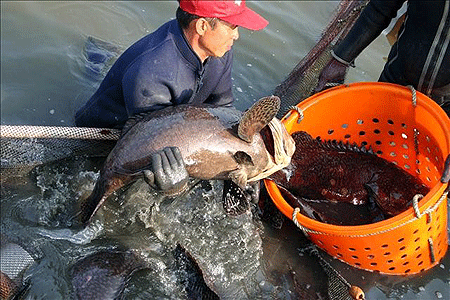
A Chinese Fish Farmer Holding a Giant Grouper (Credit Burt Lum- Courtesy of Cheng  Ann-Chang)
Thus Africa and Zimbabwe need a serious relook on this particular sector in order to close the gap and ensure fish protein self-sufficiency. The benefits of this sector cannot be overemphasized. Many African communities struggle to acquire sufficient protein dietary requirements to sustain life. Many rely on fresh and dry vegetables as relish to accompany main staples (maize, yam, cassava and rice) and other staples (sorghum, millet, rapoko, wheat and other small grains) in the Savanna particularly in the interior of the vast continent. Protein deficiency is particularly severe during lean dry seasons.  Animal protein sources for many communities remain chicken (meat and eggs), bovine, sheep and goats (meat and milk and milk products) and pork. Plant or vegetable protein comes mainly from beans and peanuts. During the onset of the rainy season, communities also augment their protein intake from birds, insects, mice, crickets and so forth. These, however, are short-lived and cannot be considered sustainable. In the equatorial regions and sparsely populated savannas, particularly the savannas which border deserts and even in the deserts communities help themselves with bush meat. This particular protein source is unsustainable because often governments outlaw the killing of wild animals. Even where government capacity to ensure compliance is hampered by inadequate resources to monitor vast areas or where it is explicitly acceptable to hunt wild animals, the practice often results in extinction of species- due to the tragedy of commons. For those privileged African communities residing along the coasts of seas and oceans or shores of inland natural and man-made lakes, they surely harvest fish to nourish themselves and their families and in many occasions trade the surplus and eke a living, humble as it might be, from fishing.

To underscore the vital importance of fish as a source of animal protein, FAO’s authoritative paper entitled, “World Review of Fisheries and Aquaculture” stated that fish, including molluscs, crustaceans, provides more than 60% (4.5 billion souls) of the world’s population with almost 17% of animal protein in 2007/2008. Certainly there is great scope of increasing this figure, simply by broadening accessibility of fish resources to many- what aquaculture is promising and able to do.

Protein is therefore critical for a balanced diet of adults and is fundamental for the sustenance of life of toddlers and the youth. Thus people cannot talk of attainment of Millennium Development Goals (MDGs) when they cannot provide sufficient protein requirements to their citizens.

The tragedy is that the Sub-Saharan African fishing industry is fragmented and generally inefficient. It is also severely undercapitalized. So, even if the African waters have enough fish resources to provide enough fish protein to African citizens, the current scale and scope of commercial exploitation of fish is such that many, especially in the interior, remain grossly underserved. In fact, fish is one of the most expensive sources of protein in many landlocked countries and even in coastal countries the prices at which fresh fish is sold in the interior parts is beyond the reach of many. Fish, fresh fish in particular, thus remain a delicacy for the privileged few who have deep pockets to afford such a “luxury”. But how can food, important food like fish be the preserve of the select few with the rest confined to malnutrition and consequently malnutrition-related life-threatening diseases? 

As if this was not enough, Africa finds itself confronted by another demon- illegal fishing in its waters.  Africa is estimated to be losing over $60 billion yearly due to illegal fishing by foreigners off its vast coastline. These “pirate” ships engage in unsustainable fishing methods, wherein the industrial fishing vessels catch massive quantities of fish for export. They end up only keeping around a quarter of their catch – throwing the rest back dead. That callous behavior is threatening the marine life and every world citizen is a loser. But of course an African is the biggest loser, because fishing industry sustains multitudes. It is a source of livelihood for communities living along the coast. 

The scale and hypocrisy around the issue of illegal fishing was summed by Sierra Leone Head of State and Government, His Excellency, President Koroma, when he said that Sierra Leone was not allowed to export fish to the EU, but fish caught illegally in the nation’s waters are repackaged elsewhere and end up for sale across Europe. 

It is the very issue of illegal vessels harvesting fish in the East Coast, off the coast of Somalia which arguably caused the emergence of an ancient criminal activity of piracy. But when piracy is properly defined surely the Somali rebel is as guilty as the crew of the illegal fishing vessels, for they all practice piracy.

African leadership in conjunction with world leaders should do something urgently to stamp this scourge. Hope is not lost and we acknowledge individuals who have continued to highlight this issue in the international fora. One such distinguished world citizen is Gareth Thomas, the UK’s International Development Minister. It is refreshing to hear him saying, “I call on world leaders and regulators to take a much more effective approach to monitoring fish stocks, policing fishing and fishing rights, and ensuring that fish stocks survive for generations to come.”

So, if the African fishing industry was well-organized, then perhaps the natural fish resources could be enough to sustain all Africans at prices they can afford. But the truth is that it’s not and will take some time for it to develop (assuming that the marine fish stocks would have survived the current illegal fishing), thus something should be done now to assist families to access fish protein. The answer is aquaculture.

Besides provision of protein, aquaculture provides employment opportunities to communities. Successful aquaculture ventures can absorb the unemployed creating a multiplier effect to communities through increased demand for goods and services, increased revenues into the fiscus, improving capacity utilization and so forth.

The beauty of Aquaculture is that it does not compete with arable farming and can utilize waste land. The farmer who wishes to venture into aquaculture will thus increase productivity of his farm without sacrificing other profitable farm activities.

Through group marketing aquaculture can raise foreign exchange through production of fish and other products for the export market. The foreign exchange resources so generated can be used for importation of critical medicines, capital goods and payment of dues to the external sector.

Aquaculture can sustain economic growth, especially if fish projects are huge enabling the attainment of economies of scale and therefore contributing to the countries’ GDP. The projects can also undertake value addition of fish resources produced to increase value. It is pertinent to note that the bulk of aquaculture production from China come from small-scale fish farms.

What are the challenges of the small African fish farmer?
The main challenges afflicting the small African farmer in his quest to venture into aquaculture are as follows:

Capital inadequacy: African farmers are generally poor and struggle to survive from their barren communal land. Due to a combination of factors, they are vulnerable members of the society who are at the mercy of political upheavals, climatic change and economic stagnation mainly caused by huge debt overhang. They live from hand to mouth and cannot raise capital as they are too poor to save. Many are unbankable. External intervention from governments, the private sector and donor community is needed. Capital is needed for capital expenditure and working capital to ensure that the farmer rear, protect, harvest and transport the perishable product to the market in good quality.

Capacity (Technical knowhow)- Again aquaculture is fairly a new phenomenon for many African farmers. They require extensive assistance in capacity building for them to run aquaculture projects profitably and sustainably. They also require access to productive fish breeds, research on effective breeding and feeding methods, amongst others technical requirements.

Production volumes insufficient to break even- without proper planning the fish projects of small farmers may end up being for subsistence because volumes will be insignificant rendering their projects unviable. Without proper marketing channels, they may lack access to lucrative markets which boost their revenues.

Lack of feeds in their respective countries – Fish feeds have been known to deteriorate in quality over time meaning that importation of feeds might not be a viable solution to the shortage of feeds. It is a potent challenge facing farmers and countries willing to grow the aquaculture industry.

Healthy Fish  in a Successful Aquaculture Project
Way forward
A few years ago the New Partnership for Africa's Development (NEPAD) issued a declaration stating that fish farming in Africa will have to expand by 250% in the next 10 years just to maintain the present (low) per capita consumption of fish in the continent.
Aquaculture can still be practiced on a small-scale basis until consolidation occurs in future. Ideally profitable aquaculture projects should be large-scale producing several tones of fish per annum and be highly mechanized with ability to add value to the produce to generate more revenue. These large projects operated by the private sector, but monitored by governments for environmental protection, will embark on out grower schemes subcontracting small famers to produce targeted amount of fish. This model will address the capital and capacity constraints and guarantees a ready market for the smaller farmer, who ordinarily would find it difficult to secure lucrative markets.
It would appear aquaculture’s success is tied with industrialization of Africa. Many African countries require industrial capacity to manufacture fish feeds which can reach farmers in good quality for profitable fish operations.
The importance of aquaculture currently and in future is immense. In 2006 aquaculture accounted for 43% of total global fish food supply and by 2008 the contribution had risen to 46%. It is therefore fair and reasonable to predict that by 2050, aquaculture will dominate the world fish food supply contributing upwards of 60%. But Africa and Zimbabwe needs to do something now not only to close the gap but more importantly to guarantee animal protein self-sufficiency at household level. 

Friday, 15 June 2012

THE GREATEST MIRAGE


“Farming is a business,” so they say. The idea of farming is not to grow and rear your own food. Surely one cannot be called a farmer if he/she does that, for any able-bodied person can do just that. A farmer thus is a person who has decided to specialize in the industry of farming i.e. to find dynamic ways of sourcing inputs and see to it that the same inputs are sweated in a mix with his physical environment to produce outputs which are more than his needs, with the rest being channeled into markets. The wealth and indeed the food of many will definitely grow, if few amongst us specialize in farming with the rest being involved in other areas of specialization. It is a concept that was explained eloquently by Adam Smith in the Wealth of Nations (1776). 

Currently, many people who call themselves farmers are definitively not farmers. Their output is dangerously low and their ventures are under-capitalized rendering their endeavors subsistence with no benefit to the nation but causing immense environmental degradation. Linked to that is overgrazing, which is caused by too many animals exceeding the carrying capacity of the land or poor grazing methods.

Why would inhabitants of ecological regions 4 & 5, situated in the Kalahari basin put so much effort and money to grow crops without irrigation infrastructure? Why would government year after year assist these same people with inputs, including hybrid maize seed suited for high rainfall areas, knowing very well that their chances for a bumper harvest are next to none? 

It is an indisputable fact that all developed countries escaped poverty because of industrialization and not through subsistence agriculture. This does not mean agriculture is not important, it is a vital sector and perhaps a spring board for sustained industrialization, but only if output is high because of consistent capital, preferably private capital, is employed coupled with technological advancement in disease and pest control and improved seed varieties. It is industrialization or value addition of agricultural output amongst other industrial activities which lift populations out of poverty. Private ownership of the land, transferability of land and collateral value of land are key factors. To exorcise the demons of poverty we ought to do the following: 

Firstly, we should acknowledge that not everyone can be a farmer. That is a simple but powerful statement, for from therein opportunities outside agriculture would be pursued. If folks are aware that there is life, perhaps a more rewarding life outside farming, then we would have partially solved the problem.

Secondly, we need a vibrant industry across Africa to serve the burgeoning populations and export markets. Industrialization of Africa should be a culmination of a well thought out and properly implemented plan leveraging on Africa’s relatively cheap labor and abundant natural resources. Currently, factors militating against sustained industrialization can be broadly categorized as infrastructure bottlenecks, trade barriers and policy issues. Allow me to briefly focus on these issues:

The current electricity supply in Africa is such that serious industrialization cannot take place. This is despite the fact that the proposed Grand Inga Dam in the Democratic Republic of Congo has capacity to generate sufficient power to cater for central and Southern Africa at current electricity consumption. What is that which makes Africa fail to unlock this critical resource? Planning of electricity supply is woefully bad, for example many governments are aware that with current urbanization electricity demand will greatly outstrip supply, but they seem oblivious to that glaring reality. Road networks, rail infrastructure, ports and pipelines are also in a deplorable state, because somehow governments thought these things will maintain themselves. The concept of depreciation completely eluded them. So even if industrialization does take place, how do we push the finished goods both within and outside Africa?
The Inga Dam on the Congo River, DRC

Trade bottlenecks result from explicit uncompetitive trading barriers between African states. Of course we are aware that developed countries have heavily subsidized their farmers thus strangulating poor African farmers. But if truth be told, the trading tariffs currently between African countries are prohibiting free flow of goods and services, thus reducing the trade volumes. Reasonable tariffs under the auspices of the World Trade Organization (WTO) to safeguard local industry may be allowed, but unreasonably high trading tariffs informed maybe by the need for increased revenues into the fiscus have an unintended effect of killing industrialization agenda in sub-Saharan Africa. 

Implicit trading barriers emanate from archaic ports of entry, manned by clearly tired personnel using outdated physical and IT infrastructure. Moving goods across countries is not only a headache but a nightmare because trucks spent days if not weeks and sometimes months clearing goods at these border posts. The costs to entrepreneurs are therefore sky-high and will naturally deter them from engaging in such endeavors robbing governments of much needed revenue and confining their citizens to poverty. 

The proximity of Africa to international markets, long considered a hindrance to trade by economists is not, in my view, a critical factor. As I pen this article and as you read this article, vessels of plunder, are harvesting fish illegally in African waters, robbing African children of their heritage and well-being. Geographically, Africa is perfectly located to conduct trade with the Western Hemisphere, The Northern Hemisphere, The Eastern Hemisphere and indeed the Southern Hemisphere. The growing African middle class will soon be sufficient to power industrialization initiatives.

In the long-term, capital shall be mobilized from both the domestic (African Markets) and external markets to build canals criss-crossing Africa to resolve the problem of high transport costs from the hinterland. Let it be emphasized that meaningful industrialization and development will take place if mechanisms have been found of reducing high transport costs incurred by manufactures in transporting both raw materials and finished products. Naturally this discussion will lead us to the problem of many African countries i.e. being land locked. Empirical evidence suggests that in majority of cases coastal areas record greater investment and prosperity than landlocked areas. There are pockets of prosperity in the interior mainly due to natural resources endowment, but these are few.

Jeff Sachs, “the doctor of the world’s financial crises”, in his work, The End of Poverty, he was spot on by declaring that, “Many of the world’s poorest countries are severely hindered by high transport costs because they are landlocked; situated in high mountain ranges, or lack navigable rivers, long coastlines or good natural harbors.” 

Policy issues relates to the policy frameworks enunciated by various African governments with respect to trade. To what extent have the concepts of active value addition and rigorous import substitution been fully integrated into the legislative and government policy? Are African countries serious in pursuing technological transfer and capacity building leveraging on South-South Cooperation? Are African governments earnestly and honestly interested in industrialization and therefore urbanization?

Besides addressing these issues which are apparently limiting industrialization and thus creating serious pressure on arable land, there are recommendations which I would like to put forward to increase agricultural productivity in Africa? 

Africa should therefore free land for commercial agriculture to feed its population and provide much needed raw materials for industrialization. This should be bold and deliberate to ensure that private capital, including resources mobilized by the financial services sector, can be directed into agriculture. The commercialization of agriculture should not result in displacement of communities, but should be carefully designed as win-win partnerships. So it is only logical that where families have ample food at prices they can afford, they would not continue to labor on infertile small plots.

Irrigation support to small but successful farmers is also recommended not solely to sustain productivity, but to supplement commercial agriculture. Contrary to popular view support of numerous small holder farmers is not a panacea to solve agricultural productivity issues and reduce poverty in Africa. Economic theory dictates that economies of scale are only possible when sufficient capital is marshaled towards a bigger plot to reduce overheads and increase revenue per unit of land. What development partners and international donors are doing to ensure food security at household level is laudable, but their interventions should be considered transitory and in the long-run a new paradigm, a new approach is needed not only for ensuring food security, but for accelerating industrialization.

Most of the cattle in my country, Zimbabwe and indeed across Africa does not constitute the commercial herd, but rather used mainly for insurance, paying bride price and pulling the plow. They are rarely slaughtered for meat consumption, because doing that borders on taboo and rightly so, for they shield these families from external shocks and constitutes family wealth and status bequeathed by previous generations. The present owners are duty-bound to see to it that they also pass on the wealth to future generations. But there are mechanisms of ensuring that the current uses of cattle are properly addressed in Africa such that very few people will desire to own them. To replace this herd would be a well run commercial herd financed by private capital, of course not owned by one entity or few individuals, but by many farmers who are adequately financed and with land with capacity to keep such livestock. I am very positive that the majority will rather work in a factory and earn money to secure an insurance policy, buy food and have a decent accommodation.

In conclusion, it is fair to say that the idea that everyone can be a farmer is the greatest mirage. The belief that small holder farmers in Africa will increase productivity of food crops both for industry and the continent’s food security is a mirage. Yes we can continue supporting them as a means of a safety net, knowing very well that a new approach is crying for implementation. Private capital should fund agriculture in Africa as has been the case throughout the world. Rural-urban migration should not be cynically viewed, but should be encouraged in our circumstances. Rural areas won’t be neglected but continue to be developed to cater for bona fide farmers who shall feed the urbanites. A select few small but productive farmers would be supported, say through irrigation, technical services and marketing to complement commercial agriculture, but by and large agriculture will be carried out by commercial enterprises.

It is no surprise that as I write this article today the Brazillian Cerrado remains the true reservoir of the world’s grain and oil seed. Here, the climate and soil types are almost the same as the African Savannah; in fact the Brazilian Cerrado is an extension of the African Savannah or vice versa, for in Gondwanaland, these constituted one stretch of land.

According to the Economist (August 2010) quoting Mauro and Ignez Lopes of the Fundacão Getulio Vargas, a university in Rio de Janeiro, half of Brazil’s 5m farms earn less than 10,000 reais a year and produce just 7% of total farm output; 1.6m are large commercial operations which produce 76% of output. So my argument that the future engine of agricultural productivity is located in commercial agriculture and not in small holder farmers is valid and already in motion.

Though the Green revolution as propounded by Norman Borlaug, an American, was based on a cocktail of interventions including but not limited to use of high yielding varieties “HYV”, synthetic fertilizers and agrochemicals, it is agreed that such interventions will not cause a significant increase in food in future, rather it will be on increase of land under cultivation caused by increased capital deployment and appropriate technology to harvest and utilize scarce water resources. For that reason, there are two places where land will come from: the Brazilian Cerrado and the African Savannah. New farms in Brazil are known to exceed 20,000 hectares, dwarfing the biggest farms known to mankind. 
A mega farm in the Brazilian Cerrado
It should be noted that the potential arable land in India and China is less than 50% of the currently cultivated land, meaning that these two emerging giants will face food sufficiency issues at current rate of population growth, unless some miracle crop and animal varieties are discovered. But they need not to worry, for the answer is the Brazilian Cerrado and the African Savannah. Serious capital is therefore required to transform these vast waste lands into high productivity farms, powering industrialization and urbanization and lifting the populations out of poverty, while feeding domestic populations with the processed food exported to feed the world, at prices afforded by everyone.

Wednesday, 23 May 2012

Small Grains a Way to go for Zimbabwe


Reports from Zimbabwe that almost two thirds of the maize crop of the 2011/2012 agricultural season is a complete write off points to a grim future for rural communities particularly in dry regions. It would be difficult for communities to scrap through a year until April 2013, when a new crop would be harvested, assuming that the heavens would be generous next time around. 

Government has made assurances that no one will starve and that every effort would be made to ensure that grain is moved from grain surplus regions to deficit areas and that additional grain would be imported to augment the Grain Marketing Board (GMB) stocks. In addition there have been assurances that poor rural dwellers will receive grain through GMB grain loan scheme. 

However there are disturbing reports that villagers have begun selling livestock at massive discounts to their market value to obtain grain to feed their families. Rural farmers are reportedly selling cattle at over 200% discount at prices around USD150 and in some cases a paltry USD100. Thus rural communities are losing wealth because of grain shortages. It is against such background that I propose a policy framework to support small grains in Zimbabwe.

Government has acknowledged that small grains should be actively pursued as a national policy. In crafting the policy framework one has to identify the current factors militating against the sustainability of small grains production when compared to other cereals like maize.

A)    Seed- There has been no coherent and systematic research regarding small grain seed. Thus farmers’ yields have continued to decline to levels which are not viable even if the market for small grains was there.
B)    Market- Rural farmers who have experimented with small grains have realized that the market for small grains is almost non-existent. Small grains are a hard sell- so they say.
C)   Lifestyles- Despite the fact that maize was popularized fairly recently among Zimbabweans, many have almost forgotten that a filling meal of millet, rapoko or sorghum can be a perfect substitute of Sadza (maize meal porridge).
D)   Pests - Destruction of small grain crops by Quelea birds. 

REMEDIES
A well crafted policy framework for small grains should address the above issues and provide interventions and regulations which will resuscitate these critical but dying crops.

There is no doubt that given hybrid seed, farmers of small grains would see their yields increasing. A framework for resuscitating the small grains should address the issue of seed. Seed houses will be encouraged and assisted to prioritize small grain seed in their research, production and ultimately marketing.  However, given that many seed houses are privately owned the business case of small grains would initially be difficult to sell to shareholders. Thus government might need to subsidize seed producers until market forces can sustain the seed production on profitable basis.

The market for small grains is quite thin currently largely due to consumer preferences for maize. Thus a concerted effort to demystify the negative perceptions of these crops is needed. Massive campaigns to raise public awareness on the value of small grains are required. These campaigns are perhaps effective if food processors begin to incorporate the small grains in their food manufacturing processes and market them properly. 

Delta Corporation contracted farmers to grow sorghum for years and that system has worked perfectly well.  Recent research has shown that there is still a gap between the contracted sorghum and the potential yield. Only 25% (1000 tonnes) of national sorghum requirement is produced through the contract scheme with the 75% (3000 tonnes) being the gap in a market of 4000 tonnes of the crop. It follows therefore that if there was an active support of sorghum to complement Delta, then production will naturally rise to fill the gap. The market failure in this regard needs further interrogation. However, the GMB should increase efforts to support the farmers with logistics and marketing of the sorghum and other small grains.
A sorghum crop ready for harvest
It is however a myth to say that there is no market for small grains. A new African sovereign state - South Sudan’s staple food is sorghum and millet. Surely a mechanism of marketing and exporting surplus sorghum and millet from Zimbabwe to South Sudan is feasible and viable in the medium to long-term, given that the both countries are members of the Common Market for Eastern and Southern Africa (COMESA) preferential trade area.

Again government should facilitate and encourage the development of the commodities market of small grains through partnering with the private sector. This market will not only assist in price discovery of small grains, but will create forward and backward linkages between food processors, financiers, investors, agro-dealers, speculators and farmers to sustain the market of small grains. I am aware of the work of local and international NGOs and developmental partners that have teamed up with agro-dealers in providing support to rural farmers through a voucher system. Such efforts are lauded and should extend to small grains and other traditional food crops like cassava, cow peas, round nuts, runinga etc.

The health advantages of consuming small grains are well documented and studies have confirmed that a daily intake of a diet of sorghum, millet, rapoko complimented by soya bean mix will go a long way in boosting one’s immune system. Again the private sector is fundamental in ensuring the uptake of these foods through proper branding and marketing to health conscious individuals.
A delicacy: Sadza rezviyo (rapoko porridge) and kapenta fish
 (courtesy of Field to Feast: www.fieldtofeast.blogpost.com)

The Zimbabwe prison service has struggled to feed inmates and reports of malnutrition have been reported. Specially formulated foods using small grains to provide all the nutrients to sustain life can be designed to feed inmates. Government hospitals should also be encouraged to feed patients with small grain meals and that should automatically create a market and demand for the crops.

Africans should know that it is strategic to grow and consume food which is suitable to their environments. Not only will it increase food security, but will result in economic growth and development. The foreign exchange resources saved if grain importation is reduced or stopped because the country has increased small grain production would be directed to critical issues like infrastructural development. 
Thriving crops of millet in the foreground and maize in the background

Quelea birds are a menace to farmers in Zimbabwe, Southern, East, Central and West Africa. Farmers experience heavy losses because of these migratory birds. The war against the birds is ongoing and requires coordination among countries, for they know no borders. However, country specific interventions are needed to curtail the losses on small grains like millet, sorghum, wheat, rice and barely. It is also envisaged that with increase in number of farmers undertaking small grains production, then perhaps the damage would be somehow spread and thus overall production will increase. In fact the birds are a ready source of protein for rural communities and the urban poor and mechanisms of harvesting them for food should be actively explored.

Therefore a framework of resuscitating small grains is urgently required to breathe life into this important sector. Government and the private sector should continue working together and support farmers who are eager to embark on this fruitful and rewarding journey. There are few options, for small grains is the way.

Friday, 27 April 2012

A Multi-sectoral Approach to Avert a National Disaster in Zimbabwe


After reading the article: Dying Rivers Dry up Livelihoods, published by Irin News and which appeared on Zimbabwe Situation website on 26 April 2012, I felt compelled, as a Zimbabwean, to attempt to proffer remedies, which I believe can go a long way in ameliorating and perhaps reversing this sad situation.
When Zimbabwe started experiencing economic difficulties in the late 1990s, communities responded in different ways. The survival strategies took many across the borders to acquire wares which they brought back to sell. The favorite destination was South Africa but others explored other countries such as Botswana, Mozambique, Zambia and Tanzania. The well-to-do even went as far as Dubai, China, and Singapore. Though the wares were sold to urban dwellers through flea markets or home delivery, some enterprising people soon discovered that there was a captive market outside towns and cities. Many trekked to the great dyke, where a phenomenon called “kukorokoza” or gold panning was taking root. 
 
Undeterred by arrests and various operations carried out by the government and the Reserve Bank of Zimbabwe to curtail their activities, gold panners became part and parcel of society. Soon a renowned musician, the late Tongai “Dehwa” Moyo acknowledged them in one of his hits. It would appear that “Makorokoza” are here to stay. The concept of “kukorokoza” is also no longer confined to gold panning but now refers to the life of many Zimbabweans who, on each and every day, have to come up with a “plan” of seeing them through. 

Come the land reforms in early 2000, many people secured plots, specializing in tobacco farming. However, it is known that many farmers had limited means to acquire coal at the prevailing prices for curing their tobacco and they naturally resorted to indiscriminate cutting down of trees. What is happening in Zimbabwe is a classic case of the tragedy of commons. Because tobacco farmers are interested in revenue, they embark on destruction of indigenous forests. The top soil is washed away into rivers and rivers dry up disrupting agricultural activities downstream, resulting in people deserting agriculture either to become panners or engage in buying and selling of wares. The desertification will fast catch up with the tobacco farmers who shall see their yields declining because of reduced rainfall. An attempt to create dams will be futile because the dams will be affected by siltation. When the alluvial gold deposits are eventually exhausted, the panners will be left with only one economic activity  of buying and selling, but because the rural farmers who left the land and urban dwellers are already into buying and selling, the buying and selling industry will become saturated and will collapse or reward big players, with the rest faced with starvation. 

My interventions will be premised on the realization that what we are staring as a country is a national disaster which needs a multi-sectoral approach coupled with vigorous planning and diligent implementation and evaluation.

The concept of “kukorokoza” or infomalization of the economy should be addressed. The coalition government should strive to capacitate industry and to do more in resuscitating and revitalizing dying industries such that people are formally employed. The benefits of formal employment to the economy cannot be overemphasized. The retail and financial sectors will receive a boost. The fiscus will also be boosted. The pension funds will provide the country with long-term development resources for sustainable infrastructural development. Entrepreneurship will be nurtured in a systematic manner.

A new mining policy is urgently required, which policy should provide a framework of how the activities of panners and small-scale miners can be regulated. Such policy will on one hand make panning difficult for unlicensed miners while allowing those licensed to take care of the environment. Government agencies such as Environment Management Agency (EMA) would be roped in to assist in monitoring the activities of miners. Funding of EMA activities in this regard will come from the miners through a levy on their sales. 

The tobacco farmers have everything to lose due to their recklessness and self-centered behavior. They should be sensitive and work harder to preserve and conserve the environment. The Forestry Commission should be stricter, penalizing those farmers found on the wrong side of the law. Tobacco farmers are not sacred. Yes the country require the foreign exchange but at what cost? A reforestation levy should be levied immediately on all tobacco farmers to assist other poor farmers to establish plantations of eucalyptus trees. On the supply of coal the Mines Ministry should be liberal in issuing coal mining licenses. The current license requirements for mining coal are not helpful to up-coming miners. The liberalization of coal mining will undoubtedly result in an increase in coal production and will drive the coal prices down enabling tobacco farmers to utilize the coal instead of chopping down a 100 year old Musasa tree.  

Communities through community leaders should be more active in environment management. Ultimately communities’ well being will be in jeopardy if the environment is no longer sustaining their livelihoods. It should be a taboo to cut down medicinal, fruit and old trees. Community leaders should be empowered to penalize those who are in the habit of cutting down of trees. 

The youths should be taught continuously on the importance of the environment; the supreme value of trees and the living nature of the soil. A program of celebrating success stories regarding conservation should be initiated where awards are bestowed to individuals, communities and organizations excelling in the field of environment management. 

The ministries of environment, tourism, mines, agriculture as well as government departments and NGOs working with and/or in communities in the area of environment and wildlife management should redouble their efforts in protecting the environment.  An environment management policy should also guide and capacitate role players to deal with environmental issues.
Gold panners in Zimbabwe courtesy of Irin News
Rural dwellers in Africa rely exclusively on firewood for energy

Religious leaders are encouraged to take a leading role in protecting the environment by urging their congregations to participate in tree planting among other activities. 

Last but not least, every Zimbabwean is called upon to do more regarding the environment. They should think twice when they are about to chop down a tree, dig up a river bed, contaminate water with mercury, start a bush fire, use snares, for it is within their own hands to make a difference. Let us remember the wise words of Mahatma Gandhi, “Be the change you want to see in the world." 

Robert Mudzvova is a social, political and economic commentator based in South Africa and writes in his private capacity. Feedback to robmudzvova@gmail.com